
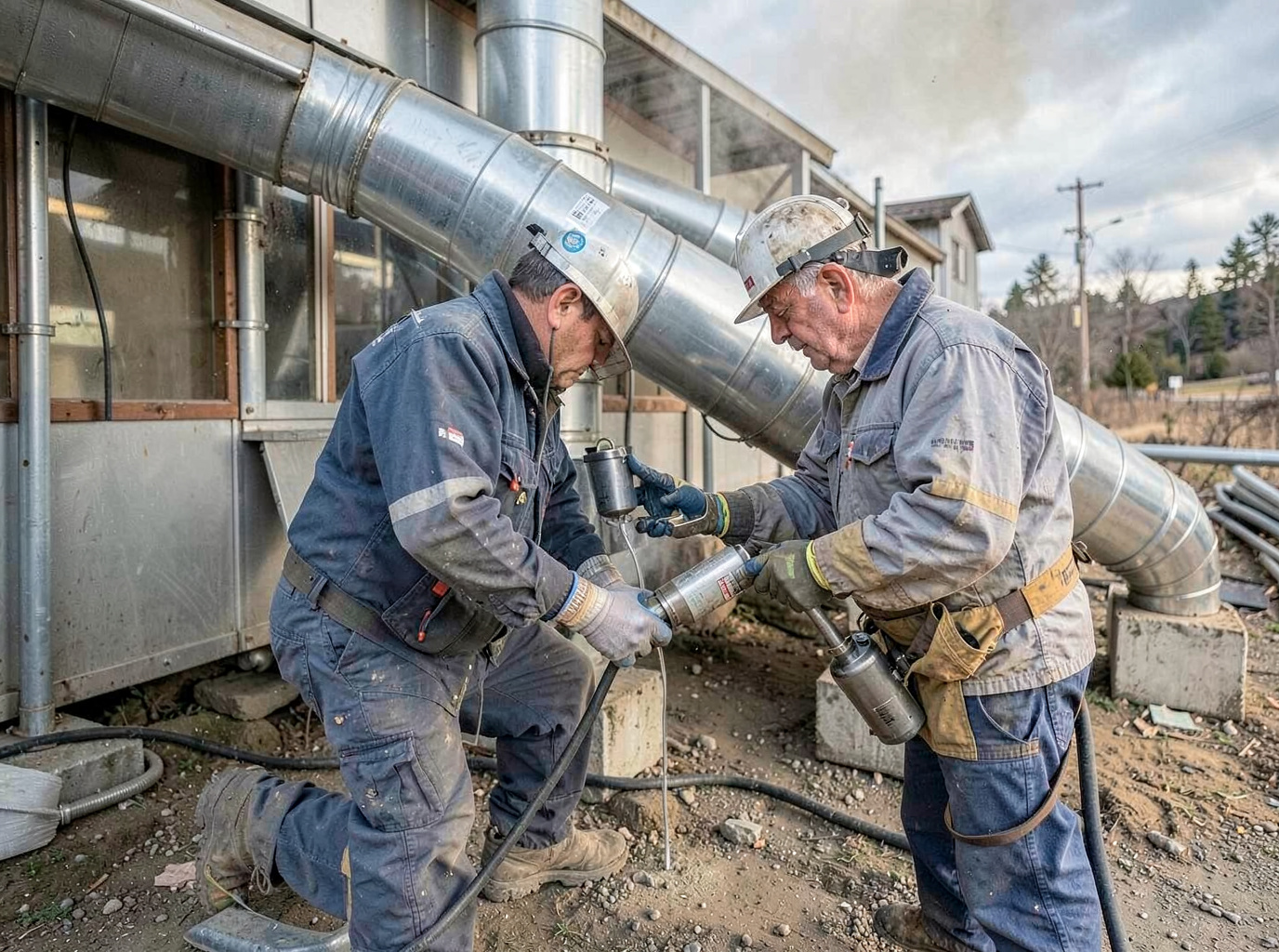
Oregon industrial buildings along the Willamette in Milwaukie and nearby Portland often date to the 1960s through 1980s and run long horizontal trunk lines that trap fine wood dust, metal shavings, and paper fibers from surrounding manufacturing. These systems pull in constant outdoor humidity during the long wet season, so condensation forms inside uninsulated ducts and supports mold colonies that standard residential equipment cannot reach. Technicians must use sectional negative-air machines rated for higher static pressure and seal every access point to keep contaminants from migrating into active production zones.
Access points in older Clackamas County warehouses are frequently blocked by racked inventory or low-clearance mezzanines, requiring temporary shutdown coordination with plant managers. Compressed-air whips and rotary brushes sized for 24-inch and larger mains are needed to dislodge compacted material without damaging spiral duct seams common in local fabrication shops. Post-clean verification includes particle counts at supply registers because residual fines can trigger equipment sensors or product contamination in food and electronics plants nearby.
Seasonal pollen spikes from surrounding fir and alder stands add an organic layer that mixes with process oils, creating sticky residues that require degreasing agents approved for industrial exhaust. Crews schedule around swing shifts to avoid interrupting 24-hour operations common along Highway 224 corridors. Proper disposal of collected material follows local environmental rules for industrial waste rather than standard landfill streams.
Technician insight
In Oregon, the thing that catches most people out with Industrial air duct cleaning is how quickly winter rain drives humidity into uninsulated ducts above unheated warehouse bays in Milwaukie and Clackamas County, turning light dust into stubborn mold mats that require extra containment steps.
Milwaukie Fabrication Shop
Heavy wood dust from CNC routers had packed into 30-inch mains above the cutting floor. Negative pressure revealed mold along two low spots where roof leaks had dripped for years. Sectional brushes and HEPA vacuums cleared the lines during the overnight shift; registers tested clean the next morning and production resumed without sensor faults.
How it works
- 1
Site Assessment
Walk the facility layout, map trunk lines, and note production schedules that affect shutdown windows.
- 2
Containment Setup
Isolate sections with negative air machines and temporary barriers to protect active work areas.
- 3
Mechanical Cleaning
Run rotary brushes and compressed air tools through mains and branches while vacuuming at collection points.
- 4
Sanitizing and Verification
Apply EPA-registered treatments where moisture evidence appears, then confirm clearance with visual and particle checks.
Pricing
Cost scales with duct diameter, total linear footage, and required after-hours access.